





Choosing between Shopify and Magento usually involves comparing cost, scalability, development flexibility and ease of use. However, for businesses selling regulated, age-restricted or potentially controversial products, there is another important consideration.
Does the ecommerce platform permit you to sell your products?
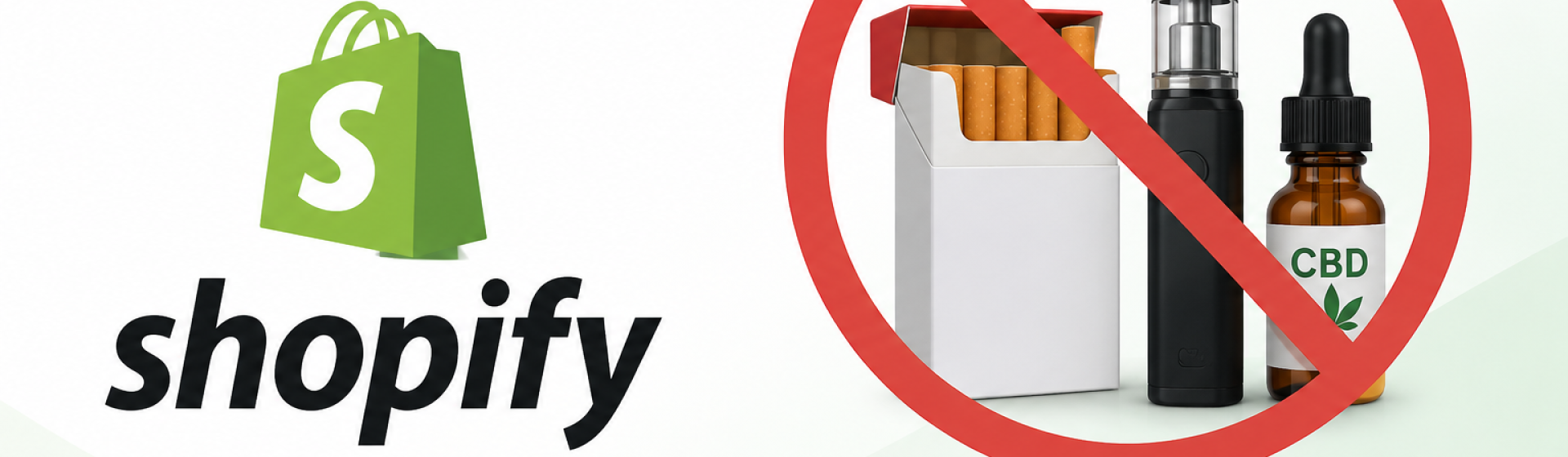
A product can be legal to sell in the UK but still be restricted by an ecommerce platform, payment provider, sales channel or fulfilment service. This makes platform selection particularly important for businesses selling products such as tobacco, vaping equipment, alcohol, CBD products, weapons, adult products, pharmaceuticals or other regulated goods.
Shopify and Magento take very different approaches to this issue.
The difference between prohibited and restricted products
It is useful to separate three different questions:
- Is the product legal to sell?
- Does the ecommerce platform permit it?
- Will the payment provider process the transaction?
These are not the same thing.
A product could be legal under UK law but unsupported by Shopify Payments. It could be accepted by the main ecommerce platform but excluded from the Shop app. It could also be accepted by Shopify and a payment gateway while being restricted by a courier, advertising platform or international market.
Shopify requires merchants to comply with the law in the jurisdictions where they and their customers operate, as well as Shopify’s Terms of Service, Acceptable Use Policy and other applicable policies.
Businesses selling regulated goods must therefore assess the complete ecommerce setup rather than looking at the store platform in isolation.
Why does Shopify restrict certain product categories?
Shopify is a hosted software-as-a-service platform. The infrastructure, platform rules and many connected services are controlled by Shopify.
This model has significant benefits. Shopify handles much of the hosting, security, platform maintenance and software updating for the merchant. It also provides a tightly integrated checkout and payment ecosystem.
However, this convenience means merchants operate within Shopify’s policies.
Restricted-product rules may be influenced by:
- Legal and regulatory risk
- Banking and card-network requirements
- Fraud and chargeback exposure
- Age-verification requirements
- Shipping and customs restrictions
- Regional differences in product legality
- Reputational risk
- The requirements of Shopify’s commercial partners
Even when a product is legal, a platform or payment processor may decide that the category introduces more risk than it is willing to support.
How is Magento different?
Magento Open Source is a downloadable, open-source ecommerce platform that businesses can install, host and extend. Adobe describes it as a flexible platform available for businesses to download and build upon.
With a self-hosted Magento Open Source website, the merchant has much greater control over:
- Hosting
- Checkout functionality
- Payment integrations
- Product data
- Age-verification systems
- Shipping rules
- Customer journeys
- Third-party extensions
- Regional restrictions
Unlike Shopify, there is not normally a central hosted-platform operator reviewing every product category and deciding whether the store can continue trading through its infrastructure.
This makes Magento potentially more suitable for businesses selling legal but regulated products, including tobacco-related goods.
However, Magento does not remove the merchant’s legal responsibilities.
A Magento retailer must still comply with all relevant laws, licensing requirements, payment-provider rules, card-network policies, age-verification requirements and shipping restrictions. The hosting company and other technology providers may also maintain their own acceptable-use policies.
Magento therefore provides greater platform control, not permission to sell illegal goods.
Payment processing can still be a challenge on Magento
Moving from Shopify to Magento does not automatically solve every restricted-product issue.
A tobacco, vaping, CBD or adult-product retailer will still need a suitable payment provider. Many mainstream gateways impose restrictions that are similar to those applied by Shopify Payments.
The difference is that Magento gives the merchant more freedom to select and integrate an appropriate specialist or high-risk payment provider.
With Shopify, a business must select from gateways compatible with Shopify and available in its region. With Magento, developers can integrate a wider range of payment services, provided the gateway offers a suitable API or Magento extension.
The merchant may still face:
- Higher transaction charges
- Rolling reserves
- Longer settlement periods
- Additional compliance checks
- Stricter chargeback limits
- Specialist merchant-account requirements
These factors should be investigated before building or migrating the website.
What happens if your products become prohibited after launching on Shopify?
This is one of the biggest risks for businesses operating in regulated or fast-changing markets.
A merchant might launch a Shopify store with products that are initially permitted. Shopify, Shopify Payments or another connected service could subsequently update its policies and make that product category restricted or prohibited.
Alternatively, the merchant may expand into a new product range that is not supported by its existing Shopify setup.
Depending on the policy and service involved, the business might experience:
- Removal of Shopify Payments
- Funds being temporarily held while an account is reviewed
- Requests for additional business or product information
- Products being removed from a sales channel
- Loss of access to Managed Markets
- Restrictions on the Shop app
- Notice that the merchant must remove specific products
- Suspension or termination of relevant services
The precise outcome would depend on which policy has changed and whether the issue affects Shopify’s platform, payment service or a separate sales channel.
Businesses should not assume that a previously accepted product will be supported indefinitely. Platform terms and payment policies can change as laws, commercial relationships and risk tolerances evolve.
What should a Shopify merchant do if its products become prohibited?
The first step is to establish exactly where the restriction applies.
A merchant should determine whether the products are:
- Prohibited across the Shopify platform
- Unsupported only by Shopify Payments
- Restricted from the Shop sales channel
- Restricted from Managed Markets
- Unsupported by a particular third-party app
- Prohibited only in certain countries
- Affected by a payment-provider or card-network rule
This distinction may determine whether a full platform migration is necessary.
For example, a merchant that loses Shopify Payments may be able to continue using Shopify with an approved third-party gateway. A merchant whose products are prohibited by the platform itself will need a more fundamental solution.