







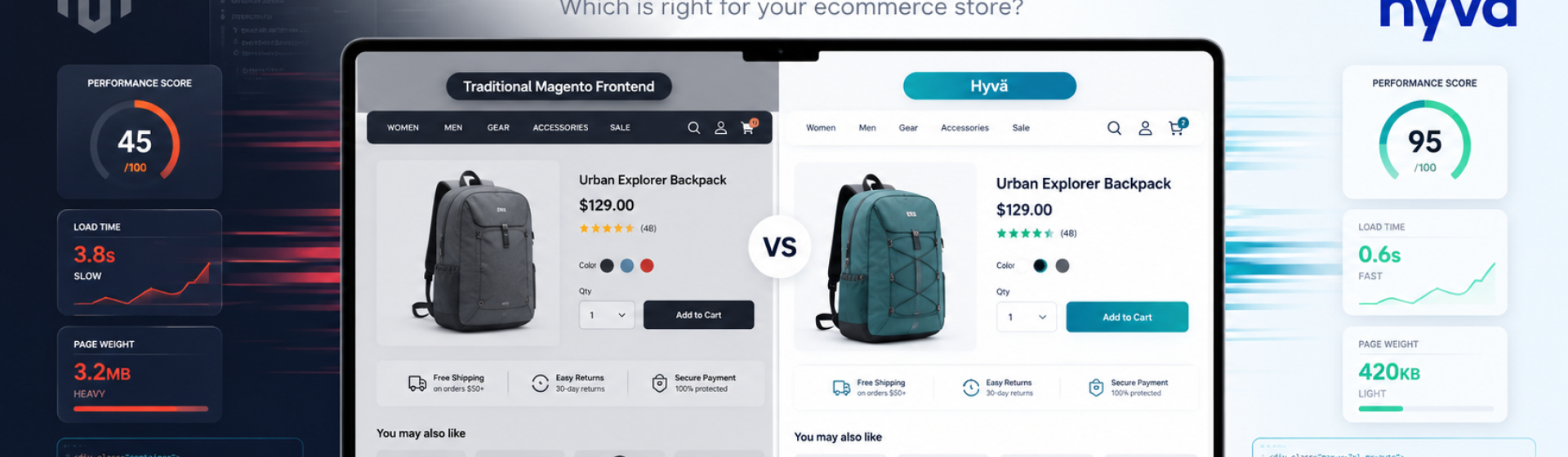
For Magento merchants, frontend performance is no longer just a technical consideration. It has a direct impact on conversion rate, SEO, paid media efficiency and the overall shopping experience. That is why more ecommerce brands are asking the same question: should we stick with a traditional Magento frontend, or move to Hyvä? The answer depends on your store, your priorities and your roadmap. But if speed, simplicity and user experience are high on the list, Hyvä is now a serious option for many Magento builds.
Why the frontend matters more than ever
Your frontend is the part of your ecommerce store customers actually experience. It shapes how quickly pages load, how easy products are to browse, and how smoothly the path to checkout feels. A slow or overly complex frontend can affect far more than user experience. It can hurt organic visibility, reduce conversion rates and make paid traffic less profitable. Pixie Commerce’s own service positioning reflects that connection, combining Magento / Adobe Commerce development with ecommerce SEO, PPC, conversion optimisation and UX.
What do we mean by a traditional Magento frontend?
When people talk about a “traditional” Magento frontend, they are usually referring to the standard Magento theme approach based on Magento’s older frontend stack and the more complex ecosystem that has historically come with it. That setup can still work well, especially for stores with highly customised requirements or existing investments in a mature frontend. But it can also be heavier to maintain, slower to develop on, and harder to optimise if performance has become a problem. For some merchants, that is manageable. For others, it becomes the reason a store starts to feel dated.
What is Hyvä?
Hyvä is a modern frontend approach for Magento that aims to simplify the frontend stack and improve performance, while giving merchants and developers a cleaner foundation to build on. Pixie Commerce highlights that it is an Official Hyvä Themes Partner Agency, and its portfolio includes multiple Magento 2 projects built with Hyvä themes, including Tiny Box Company, bott Smartvan, Farrar & Tanner, Cost Cutters UK, Trago Mills, Optics Warehouse and Signgeer. That matters because Hyvä is not just a trend topic. It is clearly part of Pixie Commerce’s real delivery experience.
Hyvä vs traditional Magento frontend: the key differences
1. Performance
This is usually the first reason merchants look at Hyvä. Traditional Magento frontends can become bloated over time, particularly when multiple third-party modules, scripts and customisations are layered in. That can create slow category pages, sluggish product pages and a poor mobile experience. Hyvä is often chosen because it gives stores a much leaner frontend foundation. That can make it easier to improve load times, responsiveness and Core Web Vitals performance. From a commercial perspective, that matters. Faster experiences tend to support better engagement and stronger conversion potential, especially on mobile.
2. Simplicity for development
Traditional Magento frontend work can be more complex and time-consuming, especially when debugging styling, JavaScript interactions or compatibility issues between extensions. Hyvä is attractive because it simplifies a lot of that frontend complexity. For merchants, that can mean faster development cycles, cleaner implementations and a frontend that is easier to evolve over time. For agencies and in-house teams, it can also mean more time spent improving the customer experience and less time fighting unnecessary frontend overhead.
3. User experience
A traditional frontend is not automatically bad for UX. There are many Magento stores with solid, high-converting traditional builds. But Hyvä has become popular because it gives teams an opportunity to rethink UX while also improving speed. That combination is powerful. A faster site that is also easier to shop can create a much stronger overall ecommerce experience. Pixie Commerce also places a lot of emphasis on UX, conversion and bespoke ecommerce design in its service messaging, which makes this comparison especially relevant for its audience.
4. Flexibility and compatibility
This is where the comparison becomes more nuanced. Traditional Magento frontends may still make sense if your store relies heavily on older module ecosystems, bespoke frontend functionality or complex implementations that are already stable and performing well enough. Hyvä can offer a cleaner route forward, but it is not always a drop-in switch for every store. Compatibility with your current setup, extensions and long-term plans all need to be reviewed properly before making the move. So while Hyvä can bring major benefits, the decision should still be based on commercial priorities and technical fit, not just momentum.
When Hyvä is likely to be the better choice
Hyvä is often a strong option when:
- your current frontend feels slow or bloated
- mobile performance is holding the site back
- you want a cleaner, more modern UX
- your team wants a frontend that is easier to maintain
- you are planning a redesign or major frontend refresh anyway
If you are already investing in growth through SEO, PPC or lifecycle marketing, improving frontend performance can also help you get more value from that traffic.
When a traditional Magento frontend may still make sense
A traditional frontend may still be the right option when:
- your current site performs well enough and does not need a major rebuild
- you have complex legacy frontend functionality that would make migration inefficient
- the business priority is elsewhere, such as ERP integration, replatforming or B2B functionality
- you need to phase change gradually rather than taking on a frontend rebuild immediately
Hyvä is not automatically the right answer for every Magento store. It is a strong answer for many stores, but not all.
What is the commercial goal?
The best frontend decision is rarely about technology alone. It is about what the business needs next. If the goal is better speed, improved UX, stronger mobile performance and a simpler frontend foundation, Hyvä can be a compelling move. If the goal is stability, phased change, or preserving a complex setup that is still commercially effective, a traditional frontend may remain the better route for now. That is why this conversation works best when it includes not only developers, but also ecommerce managers, marketers and commercial stakeholders. Hyvä vs traditional Magento frontend is not really a debate about old versus new. It is a decision about fit. For many Magento merchants, Hyvä offers a more streamlined and performance-focused path forward. For others, a traditional frontend may still be the right choice until the timing, budget or roadmap makes a rebuild more worthwhile. The key is to assess the frontend in the context of the wider ecommerce strategy.