







Did you see Google Search Console impressions in 2025?
If you opened Google Search Console in September 2025 and saw impressions suddenly fall off a cliff, you were not alone. Across the SEO industry, website owners, marketers and agencies reported the same pattern: impressions dropped sharply, average position often appeared to improve, and clicks either stayed broadly stable or moved far less dramatically than impressions.
Here are 4 anonymised impression and click graphs, directly from Search Console, from 4 of our SEO clients who see varying levels of impression drops around September 15th:
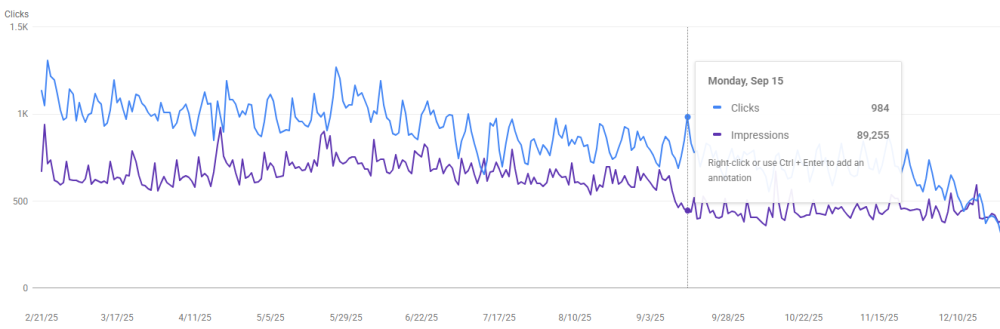
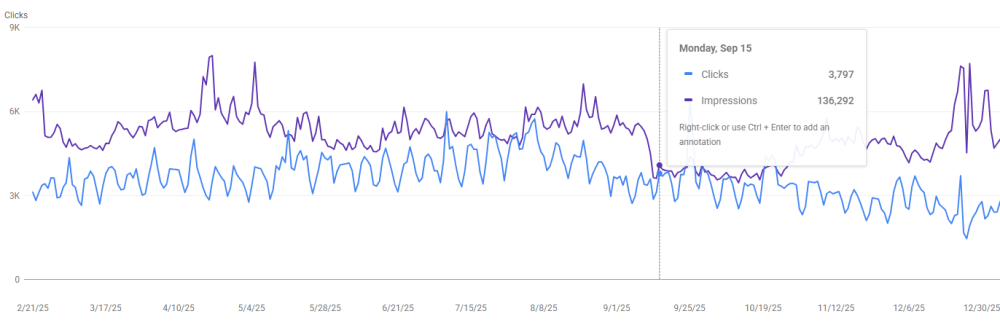
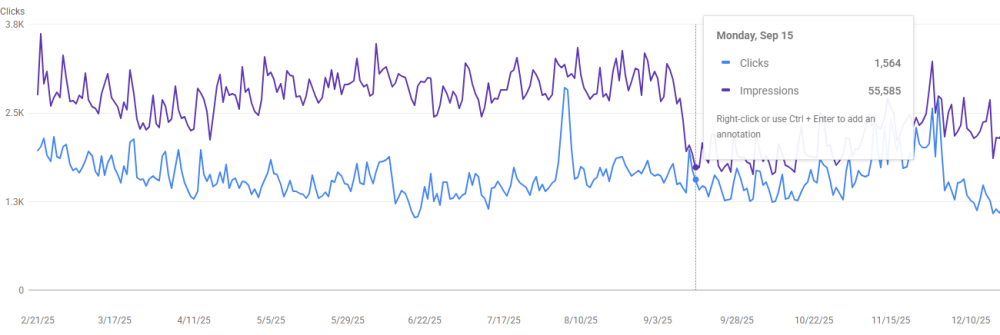
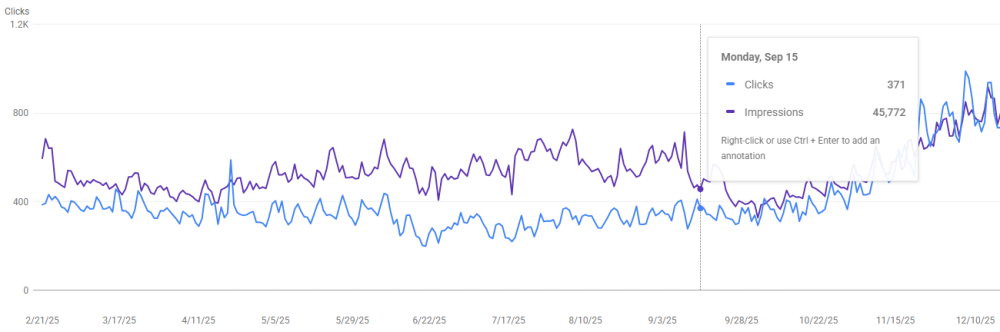
At first glance, that looks worrying. A sudden fall in impressions can feel like Google has decided to show your site less often. But in this case, the story is more complicated.
The September 2025 drop appears to have been caused by a mix of reporting changes, reduced bot-driven impression data, third-party rank tracking disruption and, for some sites, the overlapping impact of Google’s August 2025 spam update.
In other words: not every impression drop was a ranking drop.
What did we see happen in September 2025?
The biggest talking point was Google’s apparent removal of support for the “num=100” parameter.
Historically, this parameter allowed a Google results page to show up to 100 organic results at once, rather than the more typical 10 results per page. It was commonly used by rank trackers, SEO tools and scrapers because it made it easier to collect larger sets of ranking data quickly.
That matters because of how Search Console counts impressions.
If a URL appeared on a search results page loaded with 100 results, that URL could generate an impression even if it ranked in a deep position, such as 50, 60 or 90. A real user would rarely reach those positions. But automated tools could still trigger those search result pages, and those appearances could be reflected in Search Console.
When Google stopped allowing that 100 results view to behave as it previously had, many of those deep, automated impressions disappeared.
That is why so many sites saw:
- lower impressions
- fewer reported queries
- improved average position
- less visibility in long-tail or deep-ranking terms
- little or no equivalent drop in clicks
This is the key point as, in many cases, the data changed more than the search performance did.
Why did average position improve at the same time?
A drop in impressions paired with an improved average position can seem contradictory.
But it makes sense if a lot of the removed impressions came from lower ranking positions.
For example, imagine your page previously ranked:
- position 6 for one valuable query
- position 30 for another query
- position 70 for hundreds of scraped or tool-triggered searches
Before September, Search Console may have counted all of those appearances. After the change, many of the deep position impressions disappeared.
The result? Total impressions fall, but the remaining data is weighted more heavily towards higher ranking positions. So your average position can look better, even though your actual rankings may not have improved.
This is why September 2025 should be treated as a measurement reset in SEO reporting.
Was this caused by a Google search algorithm update?
Possibly for some sites, but not universally.
Google’s August 2025 spam update began on 26 August and completed on 22 September. That means it overlapped almost perfectly with the Search Console impression drop many people saw in September.
Spam updates are different from reporting changes. They are designed to reduce the visibility of sites or pages that Google believes are using spammy or manipulative tactics. If your impressions dropped and clicks, rankings, leads and organic sessions also fell, the spam update may need to be investigated.
However, if impressions dropped sharply but clicks and organic traffic stayed relatively stable, the “num=100” reporting shift is the more likely explanation.
The safest approach is not to assume one single cause but to look at the pattern.
How to tell whether your site was affected
When reviewing September 2025 GSC data, do not look at impressions in isolation. Instead, check:
Did clicks fall?
If impressions dropped by 40% but clicks only moved slightly, that points more towards reporting noise being removed.
If impressions and clicks both dropped heavily, that suggests a real visibility issue.
Did organic sessions fall in GA4?
Search Console impressions are a visibility metric. GA4 organic sessions are closer to real website traffic.
If GSC impressions fell but GA4 organic traffic stayed steady, the site probably did not lose as much real search visibility as the graph suggests.
Which device saw the biggest drop?
Many reports suggested desktop impressions were hit harder than mobile. That supports the theory that automated rank trackers and scrapers were involved, because many tools historically tracked desktop results by default.
Did average position improve?
A sudden improvement in average position at the same time as a sharp impression drop often means lower-ranking, lower-value impressions were removed from the dataset.
Did conversions or enquiries fall? For most businesses, this is the most important question. If leads, sales, quote requests or enquiries stayed stable, the drop may be more of a reporting issue than a commercial issue.
What this means for SEO reporting
If a client sees a huge impression drop, it is easy to assume something has gone wrong. But September 2025 data needs context. It may not be fair to compare post-September impressions directly against earlier periods without an annotation.
For SEO reporting, we recommend adding a note around 10–14 September 2025 explaining that Google Search Console impressions may have been affected by changes to how Google handled large result sets and automated search result collection.
A simple annotation could be:
“Google Search Console impression data changed significantly around September 2025 following Google’s removal of support for the “num=100” parameter. This appears to have reduced bot/rank-tracker-driven impressions, especially for deeper ranking positions. Treat impression comparisons across this date with caution.”
This is especially important for year on year reporting, forecasting, dashboards and SEO performance reviews.
What should businesses do?
Firstly, no knee jerk reaction is needed. A fall in impressions does not automatically mean your rankings have collapsed. It may mean Search Console is now showing a cleaner, more realistic view of the searches where your site is actually visible to users.
Secondly, review the metrics that are closer to business value:
- organic clicks
- GA4 organic sessions
- enquiries
- sales
- assisted conversions
- priority keyword rankings
- landing page performance
- non-brand traffic quality
Thirdly, separate reporting shifts from SEO issues. If clicks, rankings and conversions are stable, the best action may simply be to reset your reporting baseline. If traffic and leads are also down, then it is worth investigating the August spam update, technical SEO issues, content quality, search intent changes and competitor movement.
The September 2025 GSC impression drop is a reminder that SEO data is not perfect. Search Console is still one of the best tools we have, but it is not a direct record of human demand. It is a reporting system that can be affected by how Google displays results, how automated tools interact with search, and how Google chooses to count impressions. Similarly, tools such as SEMRush, AHrefs etc, “guesstimate” your performance and can’t be solely relied on to paint an accurate SEO picture.
For years, some websites may have been seeing inflated impression numbers from deep ranking results that were technically shown on automated search result pages, but rarely seen by real users.
The September change may have made reports look worse, but in many cases it may have made them more honest.
If your Google Search Console impressions dropped around September 2025, the most likely explanation is not automatically an SEO failure.
For many sites, the drop appears to be linked to Google’s removal of the “num=100” parameter and the disappearance of bot driven impressions from deeper search results. For some sites, the August 2025 spam update may also have played a role.
The right response is to investigate carefully, annotate your reports, reset your impression baseline, and focus on the metrics that actually drive business performance like revenue, leads, sales.